DeepSeek MODEL1
What We Know So Far

The Next Generation of Open Source AI Architecture

Discover the mysterious new model found in DeepSeek's FlashMLA repository, featuring revolutionary architectural changes and expected release in February 2025.

View FlashMLA Repository

What is DeepSeek MODEL1?

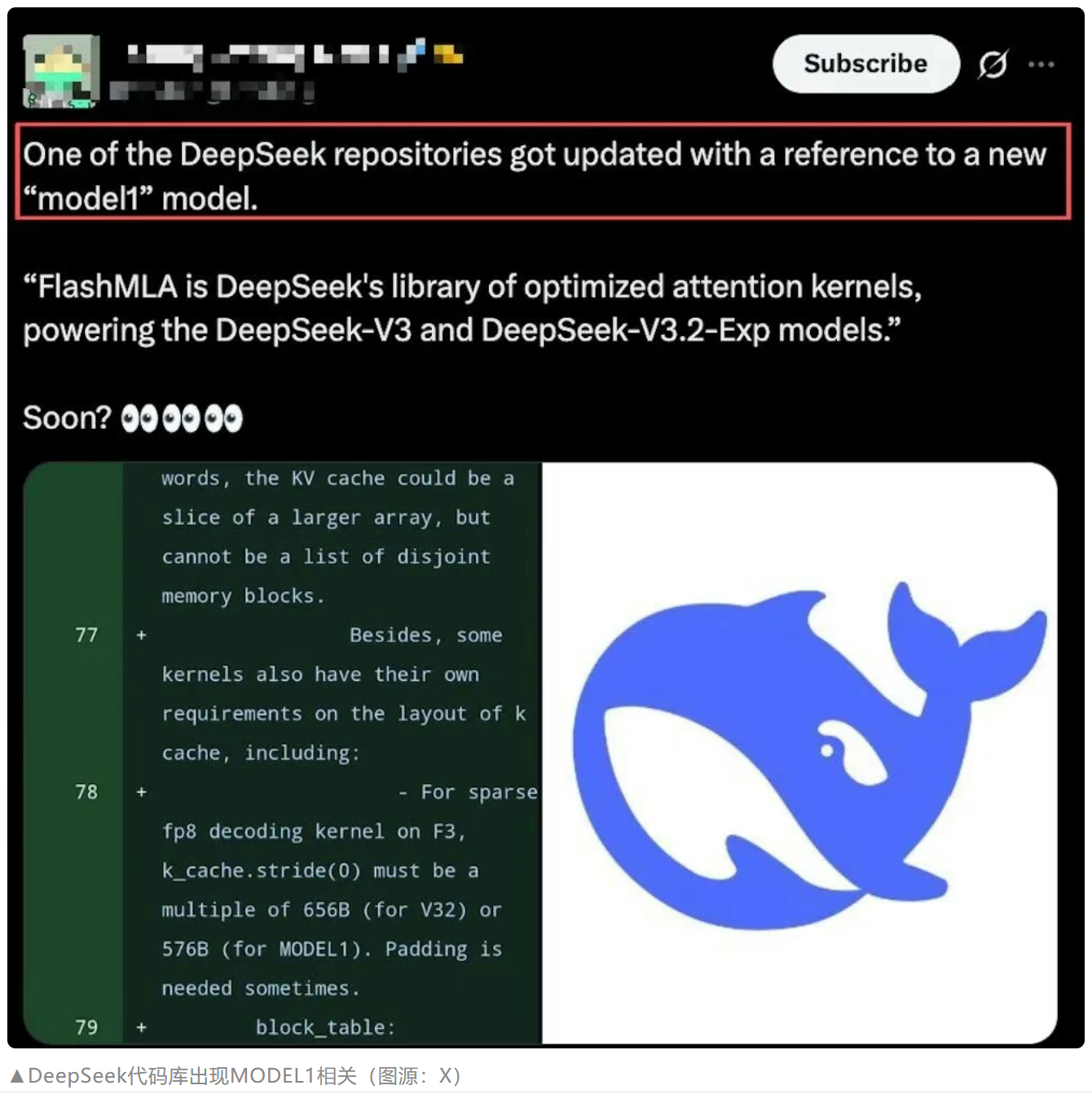
DeepSeek MODEL1 is a previously unannounced AI model discovered in the FlashMLA GitHub repository code commits. The model name appears in multiple instances within core decoding functions, specifically adapted for head dimensions of 64 and 128, and deployed on SM90 and SM100 architectures.

According to community analysis, MODEL1 likely represents DeepSeek's upcoming V4 model - the ultimate successor to the V3 series. The discovery suggests a completely different technical path from DeepSeek's existing V3.2 model, with a new inference mechanism, operator structure, and underlying memory configuration.

The model appears to be near completion, with code maturity indicating advanced development stages. Multiple core components have been implemented, including FP8 sparse decoding paths and persistent kernel designs that exist parallel to V3.2 versions.

Quick Facts

  • Discovered: January 2025 in FlashMLA repository
  • Expected Release: February 2025 (Chinese New Year)
  • Platform Support: SM90 and SM100 architectures
  • Key Innovation: Dynamic Top-K sparse reasoning
  • Memory Alignment: 576B stride (vs V3.2's 656B)

DeepSeek MODEL1 Technical Architecture

A new set of inference mechanisms and operator structures designed for next-generation AI model performance.

⚑

SM90 & SM100 Support

MODEL1 is specifically optimized for NVIDIA's SM90 and SM100 architectures, providing enhanced performance on latest GPU platforms.

🧠

64 & 128 Head Dimensions

Core decoding functions explicitly adapt to both 64 and 128 head dimensions, offering flexibility for different model configurations.

πŸ’Ύ

576B Memory Alignment

Strict KV cache memory stride requirements (576B multiples) differ from V3.2's 656B, suggesting more complex runtime behavior.

Revolutionary Features in MODEL1

Key architectural innovations that distinguish MODEL1 from previous DeepSeek models.

Dynamic Top-K Sparse Reasoning

MODEL1 introduces a variable topk_length pointer that allows the model to dynamically determine the number of keys participating in computation based on tokens or requests during inference. This enables fine-grained scheduling of computational resources and improved efficiency.

The dynamic approach represents a significant departure from static key-value selection, potentially offering better performance on complex reasoning tasks while reducing unnecessary computations.

πŸ“Š

Extra KV Buffer System

The implementation includes an additional KV cache buffer that enables separation of system prompts from user context storage. This design is particularly beneficial for Agent architectures and multi-segment context scenarios.

By providing dedicated storage for different types of context, MODEL1 can optimize memory management and improve inference efficiency for applications requiring complex prompt structures.

πŸ’Ύ

Enhanced Synchronization Logic

MODEL1 demonstrates more complex synchronization and boundary control compared to V3.2. The RoPE (Rotary Position Embedding) and NoPE dimensions are more tightly coupled in dual GEMM operations.

Runtime boundary checking mechanisms have been introduced to prevent potential illegal memory access during dynamic Top-K inference, addressing safety concerns inherent in more flexible computation patterns.

πŸ”’

Code Evidence: MODEL1 in FlashMLA

Direct evidence from the FlashMLA source code repository showing MODEL1 implementation.
FlashMLA source code showing ModelType::MODEL1 references in GitHub repository

ModelType::MODEL1 References

Direct code references showing MODEL1 as a distinct model type with dedicated implementation paths.
DeepSeek FlashMLA file structure showing MODEL1 persistent kernel files compared to V3.2

Persistent Kernel File Structure

MODEL1 persistent kernel files exist parallel to V3.2 versions, indicating independent compilation paths.

FlashMLA code annotation showing MODEL1 KV cache memory stride requirement of 576B

Memory Alignment Annotation

Code comments reveal 576B stride requirement for MODEL1 KV cache (later deleted from repository).

January 9, 2025
Foreign media first reported DeepSeek's next-generation model development, citing insider sources.
January 21, 2025
FlashMLA repository updates reveal MODEL1 code references, sparking community discussion.
Current
Developers continue analyzing code structure; memory annotation deleted from repository.

Community Reactions & Analysis

How the developer community is responding to the MODEL1 discovery.

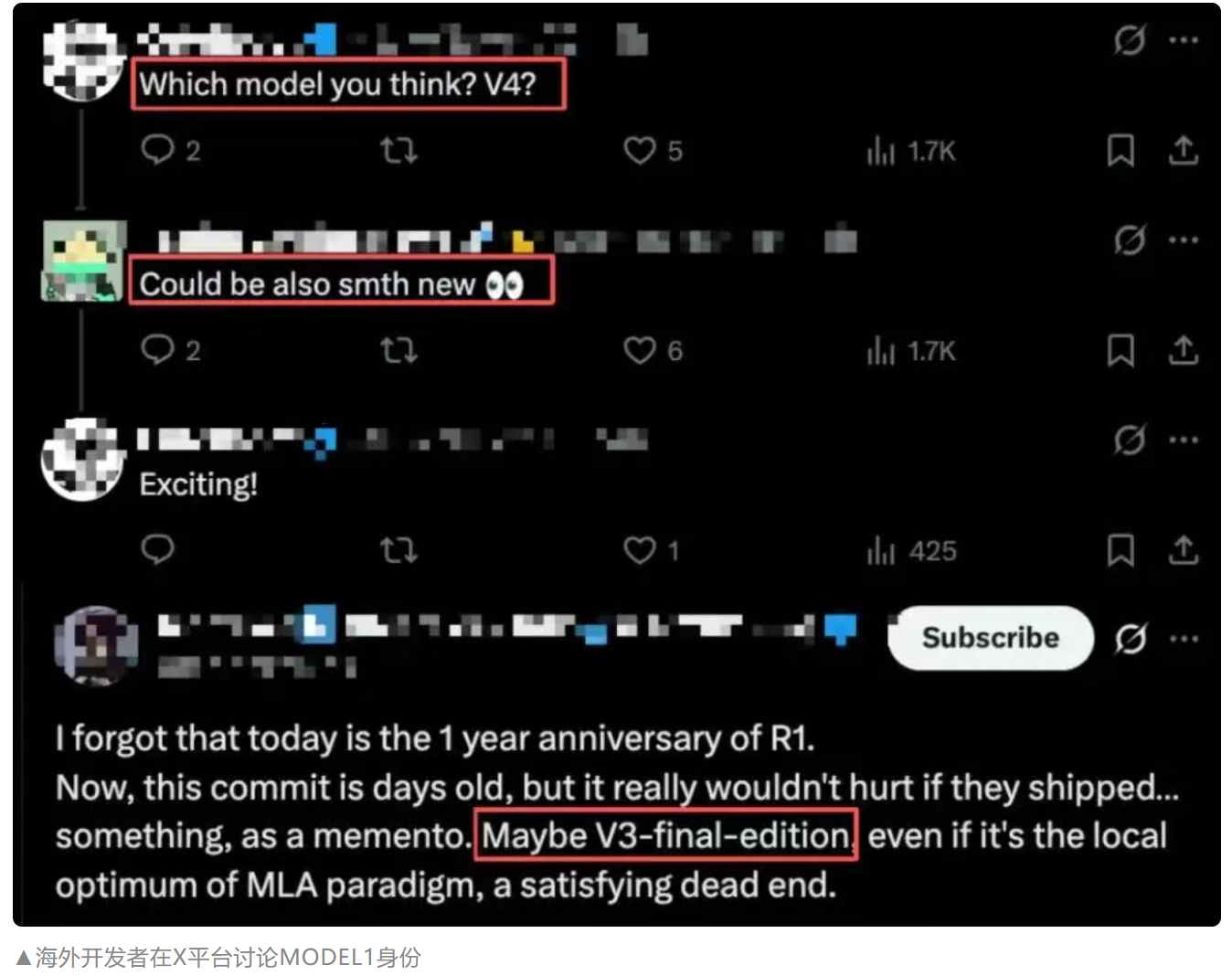
Developer Discussions on X Platform

Overseas developers discussing MODEL1 identity on X platform

Since the discovery of MODEL1 in FlashMLA repository, developers worldwide have been actively discussing its implications on social media platforms, with many analyzing the technical details and potential impact on the AI landscape.

One developer quipped: "I can already hear 'new model will bring 99.97% cost reduction' coming..." - referencing DeepSeek's reputation for dramatic efficiency improvements.

Another developer noted that if DeepSeek opens MODEL1 weights, it would "pressure closed-source giants" and advance the open-source ecosystem.

Hugging Face Recognition

Hugging Face official blog: One Year Since the DeepSeek Moment

Coinciding with the R1 model's first anniversary, Hugging Face published a special blog post titled "One Year Since the 'DeepSeek Moment'" acknowledging how DeepSeek's open-source strategy has evolved from a single event into an ecosystem strategy.

The blog highlights how R1's open-source release lowered barriers in inference technology, production deployment, and psychological accessibility, driving Chinese companies to align strategically in the open-source direction.

Technical Community Analysis

Community developers have conducted in-depth analysis of MODEL1's code structure, identifying several key technical innovations:

  • Dynamic Top-K sparse reasoning logic implementation
  • Extra KV cache buffer for system prompt separation
  • Enhanced coupling of RoPE and NoPE dimensions in dual GEMM operations
  • Runtime boundary checking mechanisms for safe dynamic inference
  • Speculation that actual memory allocation may be closer to 584B despite 576B annotation

DeepSeek MODEL1 Release Information

What to expect from the upcoming model release.

Release Timeline

  • Expected Date: February 2025 (around Chinese New Year)
  • Primary Focus: Enhanced coding capabilities
  • Benchmark Performance: Reported to surpass Claude and GPT series in multiple benchmarks during internal testing
  • Development Status: Near completion based on code maturity
  • Weight Availability: Unknown if weights will be open-sourced like previous models

Expected Capabilities

Based on insider reports and code analysis, MODEL1 is expected to feature:

  • Superior performance on coding tasks and programming challenges
  • More efficient inference through sparse reasoning mechanisms
  • Better handling of long-context scenarios with enhanced KV cache management
  • Optimized performance on latest GPU architectures (SM90/SM100)

The model appears to represent a significant architectural evolution from the V3 series, potentially establishing new benchmarks for open-source AI model capabilities.